
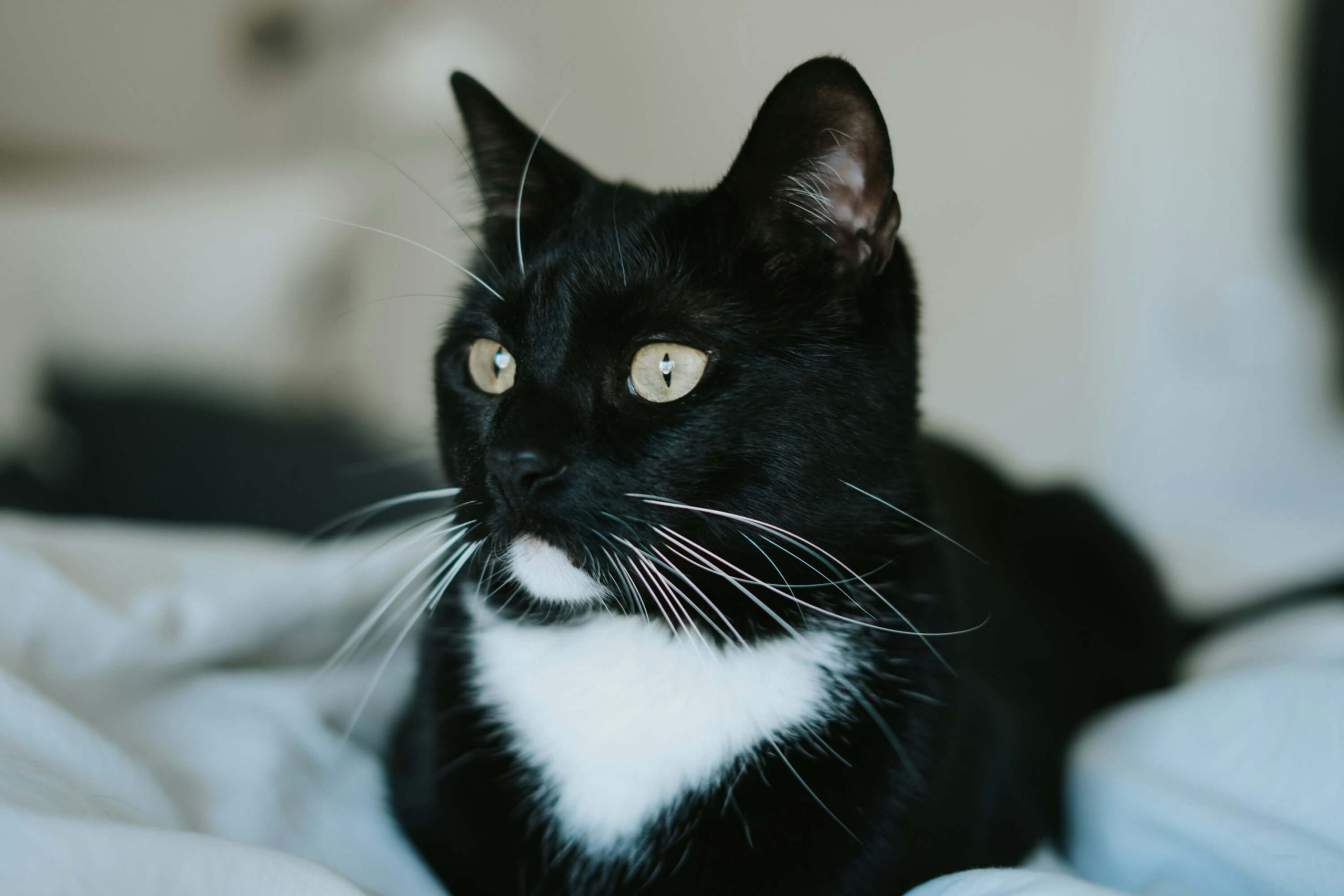
There’s something distinctly assertive about tuxedo cats. Perhaps it’s their formal appearance—that sharp black-and-white contrast that makes them look perpetually dressed for a power lunch. Or maybe it’s something deeper, a personality trait encoded in their genes that makes them unafraid to demand exactly what they want, when they want it.
My tuxedo cat Wolff has taught me that the most underestimated tool in a cat’s arsenal isn’t their claws, their teeth, or even their piercing stare. It’s their tail. Over the years of living with this distinguished feline, I’ve discovered five remarkable ways he weaponizes his tail to manipulate, communicate, and ultimately control every aspect of our household. What started as amusing observations became genuine revelations about feline behavior and the particular audacity of tuxedo cats.
Revelation 1: The Tail Slap—A Demand Disguised as Affection
The first time Wolff slapped me across the face with his tail, I thought it was an accident. He’d jumped onto my chest while I was reading in bed, turned around with his rear end facing me (a classic power move), and his tail swished directly across my nose and mouth.
I laughed it off. The second time, I noticed. The third time, I understood: this was deliberate.
The tail slap is Wolff’s opening negotiation tactic. It happens most frequently when I’m absorbed in something he deems less important than attending to his needs—working on my laptop, watching television, or heaven forbid, paying attention to another human. The technique is simple but effective: he positions himself within tail’s reach of my face and begins a rhythmic swishing that inevitably makes contact.
What makes this move particularly aggressive is its plausible deniability. If I react with annoyance, he can simply be “expressing himself” or “showing affection.” But the timing is too perfect, too consistent. The tail slap always precedes a demand: food, play, access to a closed door, or simply undivided attention.
I’ve observed this behavior in other tuxedo cats as well. My friend’s tuxedo, James Bond (yes, really), performs the exact same maneuver. There’s something about the tuxedo personality—bold, confident, unapologetic—that makes them willing to literally slap you in the face to get what they want. They’re not subtle cats. They don’t believe in subtlety.
The tail slap’s genius lies in its escalation potential. It starts gentle, almost ticklish. If ignored, the swishes become more forceful, more deliberate. Eventually, it’s impossible to ignore. And once you give in—once you close the laptop or get up to refill the food bowl—Wolff has won. He’s trained you to respond to the tail slap, and he knows it.
Revelation 2: The Wrap and Trap—Physical Restraint Through “Affection”
Perhaps the most insidious use of Wolff’s tail is what I call the “wrap and trap.” This move demonstrates not just the tail’s strength but its remarkable dexterity and his strategic thinking.
The setup usually occurs when I’m standing in the kitchen, the most resource-rich environment in Wolff’s territory. He’ll weave between my legs in that classic figure-eight pattern that most people interpret as affection. But watch carefully, and you’ll see the tail do something extraordinary: it wraps around my calf with surprising firmness, almost like a python beginning its constriction.
The first few times this happened, I’d try to step forward and find myself slightly off-balance, my leg briefly restrained by this muscular appendage. Wolff’s tail isn’t just fluffy decoration—it’s strong. I could feel the tension, the deliberate pressure, as he literally tied me in place.
The brilliance of this move is that it forces me to slow down, to stop what I’m doing and acknowledge his presence. I can’t simply step over him or around him. I have to carefully extract my leg from his tail’s grip, which requires bending down, which puts me in perfect position for him to headbutt my hand or meow directly into my face with his demands.
I started researching whether this behavior was common, and while many cats weave between legs, the deliberate tail-wrapping appears more prevalent in tuxedo cats and other confident, assertive breeds. The tail wrap serves multiple purposes: it’s a physical restraint, a demand for attention, and a territorial claim all at once. When Wolff wraps his tail around my leg, he’s essentially saying, “You’re not going anywhere until I get what I want.”
The strength required for this maneuver surprised me. A cat’s tail contains approximately 10% of their bones—nineteen to twenty-three vertebrae depending on the individual cat—surrounded by a complex arrangement of muscles, ligaments, and tendons. Wolff has clearly developed his tail musculature to maximum effect. He can maintain the wrap even when I attempt to gently shake him off, releasing only when he’s satisfied that I’ve gotten the message.
Revelation 3: The Territorial Sweep—Claiming Space Aggressively
Wolff’s third tail technique involves what I can only describe as territorial sweeping. When he wants access to a space I’m occupying—a chair, a section of the couch, a spot on the bed—he doesn’t simply jump up and settle in. That would be too passive for a tuxedo cat.
Instead, he jumps up and immediately begins sweeping his tail back and forth across the surface with broad, forceful strokes. The tail becomes a broom, clearing the space of any obstacles (books, remote controls, my phone) and essentially erasing my claim to that territory. Items get pushed to the edges or knocked onto the floor entirely.
What’s remarkable is the purposefulness of this behavior. This isn’t the absent-minded tail twitching of a relaxed cat. These are deliberate, powerful sweeps, often accompanied by intense eye contact. He’s watching to see if I’ll challenge his claim to the space.
The territorial sweep often precedes him settling into a sprawling position that occupies maximum real estate, with his tail continuing to patrol the perimeter of his newly claimed territory. If I try to reclaim any of the space, the tail immediately becomes active again, swishing warningly across the boundary he’s established.
I’ve tested this theory multiple times by placing a favorite toy or treat on the couch and watching what happens when Wolff jumps up. Rather than navigating around the object or showing interest in it, his first action is always the territorial sweep, clearing it away before investigating what it was. The priority is claiming the space first, contents be damned.
This behavior speaks to the tuxedo cat’s confidence and their tendency toward assertive, sometimes aggressive, resource guarding. In Wolff’s mind, any space in the house is potentially his space, and the tail is his tool for clearing squatters (me) and establishing dominance.
Revelation 4: The Interrogation Twitch—A Psychological Warfare Tool
The most subtle but perhaps most psychologically effective use of Wolff’s tail is what I call the “interrogation twitch.” This happens when he’s sitting or lying down, appearing calm, but his tail is engaged in a very specific pattern of movement: rapid, sharp twitches at the tip, like a snake preparing to strike.
This behavior appears when I’m not immediately responding to his demands. He’s made his needs known—he’s positioned himself by the door, or in front of his food bowl, or on top of the laptop I’m trying to use—but I haven’t yet complied. That’s when the tail starts twitching.
The twitch is a warning. It’s the cat equivalent of someone tapping their fingers impatiently or checking their watch repeatedly. It communicates displeasure, impatience, and the imminent escalation of tactics if his demands aren’t met. The longer I make him wait, the more aggressive the twitching becomes, traveling from just the tip up through the entire tail until it’s thrashing back and forth like an agitated rattlesnake.
What makes this particularly effective as psychological warfare is that it fills the space with tension. I become hyperaware of the twitching tail, unable to focus on whatever I was doing. The twitching creates a sense of urgency, a feeling that something must be done to resolve this standoff before it escalates.
And it always does escalate. The interrogation twitch is never the final tactic. If I ignore it long enough, Wolff moves on to more aggressive measures: the tail slap, knocking objects off surfaces, or his nuclear option—jumping onto the keyboard and sitting on my hands.
The twitching tail is also a display of barely contained energy. You can see the muscles rippling beneath the fur, the tension coiled in that appendage, ready to be deployed for more aggressive action if necessary. It’s like watching someone crack their knuckles before a fight—an intimidation display that says, “I’m prepared to take this further if you don’t comply.”
Revelation 5: The Alarm Clock Thwack—Weaponized Wake-Up Calls
The final and perhaps most aggressive use of Wolff’s tail is what I’ve come to dread most: the alarm clock thwack. This technique is reserved for mornings when I’ve committed the unforgivable sin of sleeping past his preferred breakfast time.
The thwack is different from the slap. A slap is relatively gentle, more ticklish than painful. The thwack is a full-force strike, delivered with the entire length of the tail, often across my face when I’m most vulnerable—deeply asleep.
The sound alone is remarkable. There’s an actual audible impact as his tail makes contact. It’s not a gentle brush; it’s a whip-crack of fur and muscle against skin. I’ve woken up convinced someone had thrown something at me, only to open my eyes and find Wolff sitting on my chest, tail still raised and ready for another strike, staring at me with those piercing yellow eyes.
The alarm clock thwack demonstrates the true strength and control Wolff has over his tail. He can modulate the force, choosing to escalate from annoying to actually uncomfortable. The message is clear: “Your sleeping is interfering with my eating, and this is unacceptable.”
What’s particularly diabolical about this technique is its precision. Wolff doesn’t randomly thrash his tail hoping to make contact. He positions himself carefully, judges the distance, and strikes with remarkable accuracy. I’ve never been hit in the eye (thank goodness), but I’ve certainly been thwacked on the nose, cheeks, and forehead with unerring aim.
The thwack is also repeatable. If one strike doesn’t rouse me sufficiently, he’ll deliver another, and another, gradually increasing the force until I’m forced to wake up and address his needs. There’s no snooze button on a tuxedo cat alarm clock.
The Science Behind the Swagger
Understanding these five tail techniques requires appreciating the remarkable anatomy of a cat’s tail and the particular psychology of tuxedo cats. The tail contains roughly 10% of a cat’s bones and is controlled by an intricate system of muscles that allow for an incredible range of motion and strength.
But not all cats use their tails as aggressively as tuxedo cats seem to. Research into feline personality types has found that coat color and pattern can correlate with certain behavioral traits, likely because the genes controlling pigmentation are located near genes that influence behavior and personality.
Tuxedo cats consistently rank high in confidence, assertiveness, and what behaviorists delicately call “willfulness.” They’re less fearful than many other cats, more likely to approach strangers, and significantly more likely to make their demands known. They’re the cats who run the household, and they know it.
This confidence manifests in their body language, and nowhere more clearly than in tail usage. A timid cat holds its tail low or tucked. A confident cat carries its tail high. An assertive tuxedo cat like Wolff weaponizes his tail, using it as an extension of his will to manipulate his environment and the humans within it.
Living with a Tuxedo Tactician
Five years of living with Wolff has taught me that resistance is futile. His tail techniques work because they’re persistent, creative, and escalate until they achieve the desired result. I’ve learned to recognize the early warning signs—the positioning, the initial tail movements—and often find myself complying before he has to escalate to more aggressive tactics.
Am I trained? Absolutely. Do I mind? Not really. There’s something almost admirable about Wolff’s determination and the sophisticated ways he’s learned to communicate and manipulate using his tail. Each technique reveals not just physical capability but genuine problem-solving and strategic thinking.
Other tuxedo cat owners report similar experiences. These formal-looking felines seem to share a personality type that embraces assertive communication and refuses to be ignored. They’ve evolved alongside humans for thousands of years, and they’ve gotten remarkably good at getting what they want.
Wolff’s tail is his primary tool for navigating the world and bending it to his preferences. It’s his most expressive appendage, his most versatile weapon, and his most effective means of imposing his will on the household. From gentle attention-seeking slaps to aggressive wake-up thwacks, from restraining wraps to territorial sweeps, from warning twitches to full-force strikes, his tail communicates volumes and achieves results that his voice and paws alone never could.
Living with a tuxedo cat means living with a creature who knows exactly what they want and has multiple strategies for obtaining it. The tail is just one tool in their arsenal, but it’s perhaps the most visible, most versatile, and most consistently effective. Wolff has taught me to pay attention to tail language, to recognize the warning signs, and ultimately, to accept my place in the household hierarchy: firmly beneath him, existing primarily to serve his needs, and honestly? I wouldn’t have it any other way.