
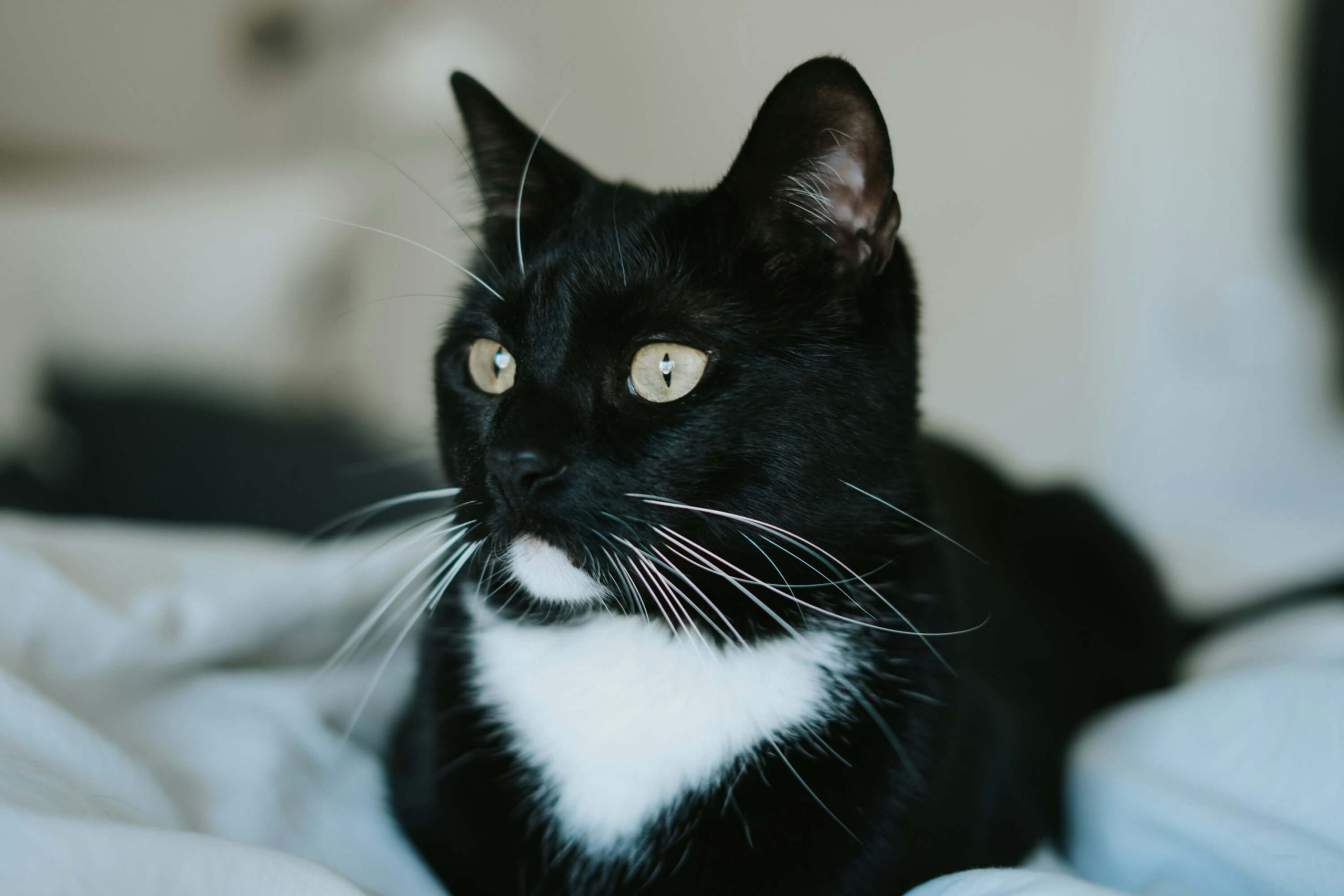
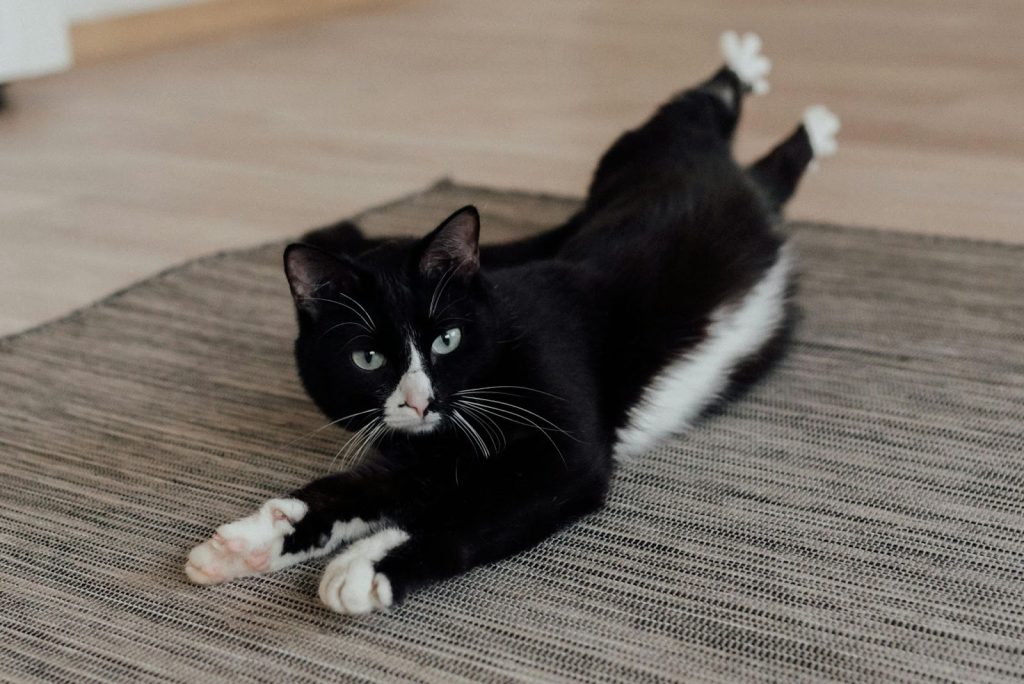
The first time I unrolled my yoga mat in the living room, Wolff did what any curious cat would do: he investigated. He sniffed the corners, tested the texture with his paws, and eventually settled himself directly in the center, forcing me to work around his luxuriously sprawled form. This, I assumed, was standard cat behavior—claiming the newest, most interesting object in their territory.
But over the following weeks, something shifted. Wolff stopped treating my yoga mat as a bed and started treating it as equipment. What my partner and I initially dismissed as coincidental stretching gradually revealed itself to be something far more intentional: our tuxedo cat wasn’t just tolerating our exercise routine. He was participating in it.
This revelation changed not only how we viewed our workouts but how we understood Wolff himself. Tuxedo cats are known for their intelligence, their confidence, and their sometimes uncanny ability to mirror human behavior. But a cat who genuinely exercises? Who engages in deliberate, sustained physical activity beyond the typical sprint-and-nap cycle? That seemed almost too anthropomorphic to believe.
Yet here we are, eighteen months later, and Wolff has become such an integral part of our fitness routine that we’ve actually started planning our workouts around his participation. This is the story of how we discovered that our formal-looking feline wasn’t just stretching—he was training.
The First Hint: Downward Cat
It started with downward dog, or rather, what I now call “downward cat.” I’d moved into the pose, pressing my palms into the mat and lifting my hips toward the ceiling, when I noticed Wolff had positioned himself parallel to me. His front legs were extended forward, his back arched, his rear end lifted high—a perfect mirror of my position.
“He’s stretching with you,” my partner laughed from the couch, phone out to capture the moment. We both assumed it was adorable coincidence. Cats stretch like that all the time, right? The classic arch-backed, front-legs-extended stretch is part of their standard repertoire, along with the equally dramatic back-leg extension and the full-body elongation that makes them appear twice their normal length.
But then it happened again. And again. Every single time I moved into downward dog, Wolff would appear beside me and mirror the position. Not before I got into the pose—he wasn’t just randomly stretching at the same time I happened to be doing yoga. He waited until I assumed the position, then deliberately moved into alignment with me.
The scientist in me wanted to test this. The next day, I skipped downward dog entirely, moving through my sequence without it. Wolff stretched normally throughout my practice—the occasional arch, the periodic leg extension—but nothing synchronized with my movements. The following day, I included downward dog again. Within seconds of assuming the pose, Wolff was beside me, matching my form with remarkable precision.
My partner witnessed this experiment and came to the same conclusion I had: this wasn’t coincidence. Wolff was observing, learning, and deliberately mimicking the pose.
Planks, Push-Ups, and Feline Core Strength
The downward dog revelation made us more observant. We started actually watching what Wolff did during our workouts rather than just working around him. That’s when we noticed the planks.
My partner had incorporated a plank routine into his exercise regimen—standard planks, side planks, and variations that I frankly found exhausting just watching. One evening, while he held a particularly long plank, I noticed Wolff had positioned himself directly next to him, body low to the ground, legs extended, holding himself in perfect parallel alignment.
“Don’t move,” I whispered, grabbing my phone. “He’s planking with you.”
For forty-five seconds, they held the position together. My partner’s arms trembled with effort. Wolff remained perfectly still, his core visibly engaged, his body forming a straight line from his nose to his tail tip. When my partner finally collapsed, Wolff relaxed too, standing up and shaking out his limbs in a way that looked remarkably like an athlete recovering from exertion.
We started paying attention to Wolff’s body during these moments. His muscles were visibly engaged—not the relaxed state of a cat lying down, but the tensed, controlled state of deliberate physical effort. His breathing was different too, more measured and controlled. He wasn’t just mimicking the shape of the exercise; he was actually doing it.
The push-ups were even more remarkable. When my partner dropped into push-up position, Wolff would position himself nearby and begin a motion that can only be described as cat push-ups. He’d lower his entire body toward the mat, then press back up, using his front and back legs in coordination. It wasn’t quite human form—his cat anatomy wouldn’t allow for that—but it was clearly his adaptation of the movement, and he’d repeat it in sets that roughly matched my partner’s reps.
“This is insane,” my partner said after one particularly synchronized session. “He’s actually working out with me.”
We couldn’t deny it anymore. This wasn’t just a cat being weird or seeking attention. This was deliberate exercise.
The Pilates Revelation
While Wolff had shown interest in yoga and strength training, it was Pilates that truly revealed the extent of his athletic ambitions. I’d recently started following along with online Pilates videos, attracted to the low-impact but challenging movements that promised core strength and flexibility.
Wolff, as usual, investigated when I first started the new routine. But instead of settling into observer mode, he immediately engaged. When I performed leg lifts, he’d lie on his side and lift his back leg in synchronized motion. When I did bridges, he’d position himself nearby and arch his back in a way that mimicked the hip lift and core engagement.
But the movement that convinced me Wolff genuinely understood what exercise was came during the “hundred”—that brutal Pilates move where you lie on your back, lift your legs and shoulders, and pulse your arms while breathing in specific patterns. I was struggling through my set when I glanced over and saw Wolff lying on his back, all four legs in the air, contracting and releasing his abdominal muscles in visible pulses.
I stopped mid-rep, astonished. Wolff never lies on his back—he’s not one of those cats who enjoys belly rubs or voluntarily assumes vulnerable positions. Yet here he was, on his back, legs extended, engaging in what was clearly an abdominal exercise.
“Are you seeing this?” I called to my partner.
We both watched, mesmerized, as Wolff continued the movement for another twenty seconds before rolling back onto his side, looking slightly winded. His breathing was elevated. His pupils were dilated. He looked exactly how I felt: exercised.
That’s when the full realization hit us both simultaneously: Wolff wasn’t just mimicking movements he found interesting. He was engaging in deliberate physical conditioning. He was exercising.
The Tuxedo Personality: Why Some Cats Work Out
After accepting that our cat was genuinely exercising with us, we became obsessed with understanding why. Was this behavior unique to Wolff, or was there something about tuxedo cats specifically that made them more inclined toward structured physical activity?
Research into feline behavior and personality types revealed some fascinating insights. Tuxedo cats—those distinctively marked black-and-white felines—consistently demonstrate higher levels of intelligence, confidence, and what behaviorists call “human-directed sociability.” They’re more likely to observe and learn from their human companions, more willing to engage in complex interactive behaviors, and generally more interested in participating in human activities rather than just coexisting alongside them.
This elevated social intelligence might explain why Wolff was not only observing our workouts but actively choosing to participate. While most cats are content to watch their humans do bizarre human things, tuxedo cats often want to join in, to understand, to be part of the activity.
There’s also the physical element. Tuxedo cats aren’t a specific breed but rather a color pattern that appears across multiple breeds. However, certain traits seem to cluster with the pattern. Many tuxedo cats are naturally athletic, with lean muscle mass, good flexibility, and high energy levels that need appropriate outlets.
In the wild, cats are remarkable athletes—capable of impressive sprints, vertical jumps six times their height, and the kind of flexibility that allows them to squeeze through impossibly small spaces. Domestic cats retain these athletic capabilities even when they don’t need them for survival. Perhaps Wolff had simply found a way to channel his natural athleticism in a structured, human-compatible way.
We also discovered that cats are exceptional observers and imitators. Studies have shown that cats can learn behaviors by watching both other cats and humans, then replicating those behaviors with adaptations that suit their own physiology. Wolff wasn’t just mindlessly copying our movements; he was translating them into cat-appropriate versions that achieved similar physical effects.
The Evolution of Wolff’s Workout Routine
Once we recognized what was happening, we started structuring our workouts to accommodate Wolff’s participation. We’d clear space on or near the mat for him. We’d pause between exercises to give him time to position himself. We even started choosing exercises that we knew he could adapt to his feline anatomy.
Wolff’s engagement intensified with our encouragement. He began anticipating certain movements, positioning himself before we’d even started the exercise. He developed preferences—he loved yoga flow sequences with lots of stretching but seemed less interested in high-intensity cardio. He’d participate enthusiastically in strength training but would sit out jumping jacks or burpees, watching with an expression that suggested he found those movements undignified for a cat of his sophistication.
His favorite exercises became clear through repetition. Cat-cow pose (ironically appropriate) never failed to get his participation. Any exercise involving core engagement and balance—like bird dog or boat pose—captivated him. Side stretches and twists were enthusiastically matched. And any movement that involved lying down or floor work was fair game for his involvement.
We noticed physical changes in Wolff over the months. He’d always been a healthy weight, but his muscle definition improved noticeably. His coat seemed shinier, his movements more fluid and confident. He maintained the suppleness and agility that many cats lose as they age. At five years old, he moved like a kitten—no stiffness, no hesitation, just pure feline athleticism.
His stamina improved too. Initially, he’d participate for five or ten minutes before wandering off, but gradually, he’d stay engaged for entire thirty or forty-minute workout sessions. He’d take breaks when he needed them, but he’d always return to the mat, ready to rejoin the activity.
The Social Aspect: Working Out Together
Perhaps the most surprising aspect of Wolff’s exercise habit was how it transformed our relationship with him. Exercise became bonding time. When we’d unroll the mats, Wolff would appear immediately, sometimes even before we’d started the workout video or music. He’d position himself nearby, waiting for us to begin, his tail twitching with anticipation.
There was something profound about this shared activity. Most cat-human interactions center around the cat’s basic needs—feeding, playing, petting. But exercise was different. This was an activity we all engaged in for its own sake, for the physical challenge and the feeling of accomplishment afterward. Wolff wasn’t asking us for anything or demanding our attention. He was choosing to participate in something we were doing, finding value in the activity itself.
My partner noticed that Wolff’s overall demeanor improved with regular exercise. He seemed calmer, more content, less prone to the kind of destructive behavior that often stems from boredom or excess energy. The infamous “zoomies”—those random bursts of frantic energy where cats sprint madly through the house—became less frequent. He was channeling that energy into structured activity instead.
We also noticed that Wolff’s participation seemed to motivate us. On days when we felt lazy or tempted to skip a workout, seeing Wolff sitting expectantly by the mat gave us the push we needed. We’d joke that we couldn’t disappoint our workout buddy, but there was truth beneath the humor. His participation made exercise more enjoyable, less solitary, and somehow more meaningful.
Sharing Wolff’s Story: The Response
Inevitably, we started sharing videos and photos of Wolff’s workouts on social media. The response was overwhelming. Thousands of people commented, liked, and shared, many with their own stories of athletic cats. Some were fellow tuxedo cat owners who reported similar behavior—cats who seemed unusually interested in human exercise routines and would mirror stretches or positions. Others owned cats of different breeds or patterns who showed comparable traits.
But many people were skeptical. “He’s just stretching,” some commented. “You’re reading too much into normal cat behavior.” We understood the skepticism—we’d been skeptics ourselves initially. But anyone who watched the full videos could see the difference between a cat casually stretching and a cat deliberately engaging in synchronized movement. The timing, the positioning, the visible muscle engagement, the sustained effort—these weren’t characteristics of coincidental behavior.
What surprised us most were the messages from veterinarians and animal behaviorists. Several reached out to explain that this behavior, while uncommon, wasn’t unheard of. Highly intelligent, socially bonded cats could indeed learn to participate in human activities, including exercise. The key factors were observation, motivation, and the cognitive ability to translate observed behavior into adapted action—all traits that tuxedo cats often possessed in abundance.
One feline behavior specialist explained that cats who exercise with their humans are engaging in what’s called “social facilitation”—a psychological phenomenon where the presence of others performing an activity increases an individual’s motivation to perform that same activity. Wolff wasn’t just mimicking for the sake of mimicking; he was genuinely motivated to engage in physical activity because he saw us doing it and receiving positive feelings from it.
The Benefits of a Feline Workout Partner
Eighteen months into this unexpected journey, we’ve identified genuine benefits to having Wolff as a workout companion. The most obvious is physical—he’s in exceptional shape for a five-year-old cat, with ideal body condition, excellent flexibility, and the kind of muscle tone that makes our veterinarian comment approvingly at every checkup.
But the mental and emotional benefits seem equally significant. Wolff appears more confident, more engaged with his environment, and more interactive with us. The mental stimulation of learning and performing complex movements likely contributes to his overall cognitive health. Studies have shown that physical activity benefits brain function in both humans and animals, potentially reducing age-related cognitive decline.
For us, the benefits are similarly multifaceted. Having Wolff participate transforms exercise from a solitary discipline into a shared experience. It adds an element of joy and humor to workouts—there’s something inherently delightful about holding a plank alongside your tuxedo cat, both of you trembling with effort, united in temporary suffering.
Wolff’s participation also serves as a barometer for our workout intensity. If we’re pushing too hard or maintaining poor form, he’ll often stop participating and watch instead, as if to say, “That doesn’t look right.” When we’re in good form and proper alignment, he matches us movement for movement. It’s oddly instructive.
The Bigger Picture: What Wolff Taught Us
Living with Wolff has fundamentally changed how we think about cats and their capabilities. We’d always known cats were intelligent, but Wolff demonstrated that their intelligence could extend to domains we’d never considered. The ability to observe complex human behavior, understand its purpose, adapt it to feline physiology, and then engage in that adapted behavior consistently over time—that requires remarkable cognitive sophistication.
It’s also challenged the narrative that cats are fundamentally lazy animals who sleep twenty hours a day and only exercise when chasing prey or toys. Wolff sleeps plenty, but he also deliberately exercises, choosing to engage in sustained physical activity that serves no survival purpose. He does it because he’s learned that it feels good, that it’s something he can share with his human family, and perhaps because it satisfies some innate need for physical challenge.
This realization has made us more attentive to other ways Wolff might be engaging with us that we’d previously dismissed or overlooked. How many behaviors have we attributed to instinct or coincidence that might actually reflect intentional choices and learned behaviors? How much cognitive complexity are we missing when we reduce cats to simple stimulus-response machines?
Wolff has also taught us about the importance of physical activity for indoor cats. Most indoor cats don’t get adequate exercise, leading to obesity, boredom, and behavior problems. We’d provided Wolff with toys, cat trees, and play sessions, but structured exercise—the kind that elevates the heart rate, engages muscles, and challenges balance and coordination—was something entirely different. The benefits we’ve observed in Wolff make a compelling case for finding ways to incorporate more structured physical activity into indoor cats’ lives.
Our Current Routine
Today, our workout routine includes Wolff as a full participant. When we roll out the mats, he’s there. When we start the video or music, he positions himself in his preferred spot—usually between us, where he can see both of us and mirror whichever human is doing the more interesting movement.
We’ve learned his preferences and limitations. He loves long stretching sequences, enthusiastically participates in strength training, and particularly enjoys any exercise that involves balance or coordination. He’s less interested in rapid movements or anything involving jumping around. He’ll participate for thirty to forty-five minutes before losing interest, at which point he’ll move to his observation post on the couch and watch the remainder of our workout with the critical eye of a coach evaluating athletes.
After workouts, Wolff exhibits the same post-exercise behavior we do. He grooms himself thoroughly—his equivalent of our showers. He drinks water. He seems content and relaxed, settling into deep, satisfied sleep that suggests genuine physical tiredness rather than just the standard cat napping.
We’ve also noticed that on days when we skip our workout, Wolff seems restless. He’ll pace around the living room during the time we’d normally exercise, occasionally performing his own stretches and strength movements as if trying to remind us of what we should be doing. He’s not just passively participating when we exercise; he’s come to expect and rely on this activity as part of his routine.
The Tuxedo Difference
While individual personality certainly plays a role, the more we’ve connected with other tuxedo cat owners, the more we’ve seen similar patterns. These formally dressed felines seem to possess an unusual combination of traits: high intelligence, confidence, strong social bonds with humans, and a willingness to engage in complex, learned behaviors. They’re the cats who learn to open doors, who figure out puzzle feeders in record time, who seem to understand far more human language than they should.
Wolff’s exercise habit fits perfectly within this tuxedo personality profile. He observed behavior, analyzed its purpose and execution, adapted it to his capabilities, and chose to participate. That requires not just intelligence but confidence—the willingness to try something new and potentially fail, the absence of fear about looking foolish or being vulnerable.
Not every tuxedo cat will become a workout partner, just as not every tuxedo cat will exhibit all the personality traits associated with the pattern. But there’s enough consistency in these observations to suggest that tuxedo cats, as a group, possess qualities that make them exceptional companions for humans willing to see them as the sophisticated, capable creatures they are.
The Joy of Unexpected Companionship
When we adopted Wolff four years ago, we expected the standard cat experience: companionship, affection, occasional entertainment, and the privilege of serving an imperious feline overlord. We never imagined we’d gain a workout partner, that our yoga and Pilates sessions would become family activities, or that we’d structure our exercise routine around our cat’s participation.
But that’s exactly what happened, and our lives are richer for it. Wolff has taught us to observe more carefully, to challenge our assumptions about animal behavior and cognition, and to remain open to unexpected possibilities. He’s shown us that cats are capable of far more than we typically give them credit for, and that the relationship between humans and cats can encompass dimensions we’d never considered.
Every time we unroll our mats and Wolff takes his position beside us, ready to stretch, strengthen, and engage in deliberate physical activity, we’re reminded that living with animals means constantly learning, constantly being surprised, and constantly having our expectations exceeded. Wolff wasn’t just stretching while we did yoga and Pilates. He was, and is, doing it too. And that simple realization has transformed not just our workouts but our entire understanding of what it means to share a life with a remarkably intelligent, athletic, and utterly unique tuxedo cat.